Optics · Engineering
Inside the X1 waveguide: a 25° display
The Focuz X1 floats a sharp green layer in your right eye through a piece of glass 0.7 mm thick — no projector box, no camera. Here's how a diffractive waveguide actually works, and the engineering choices behind ours.
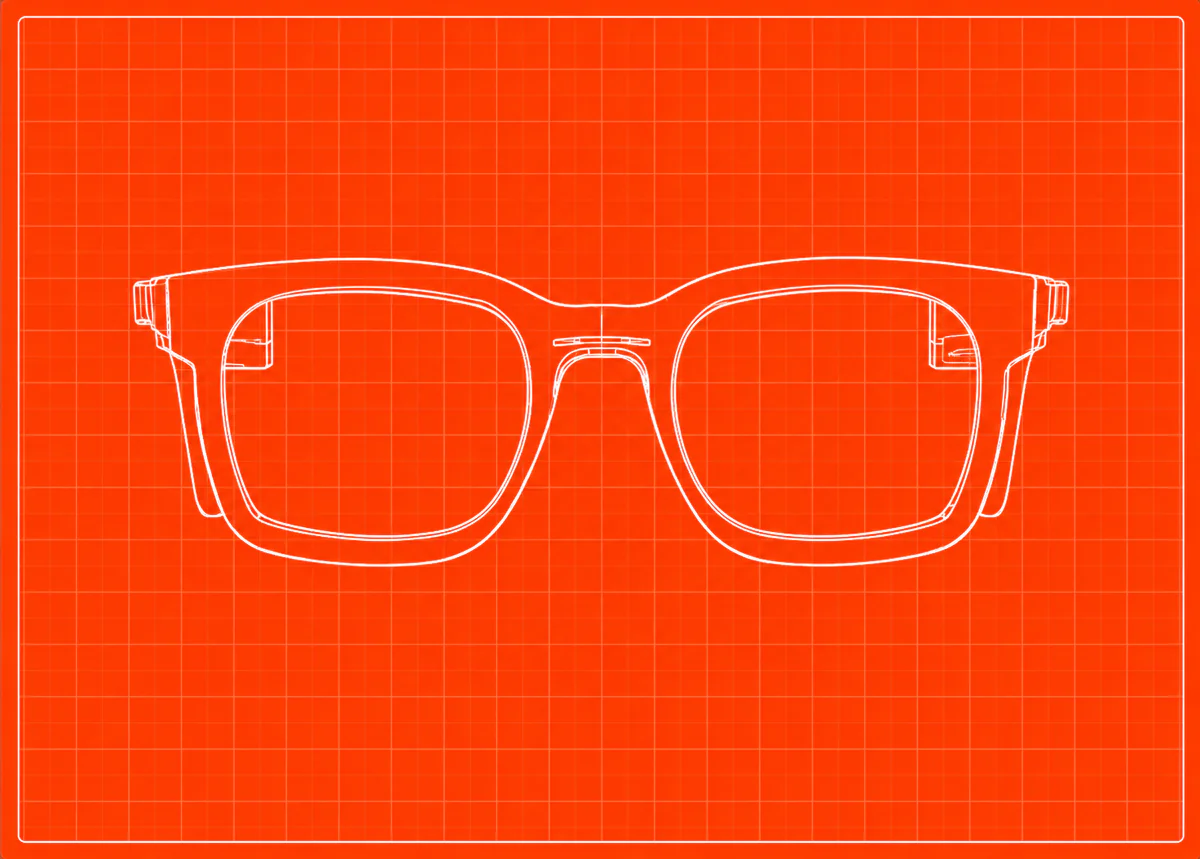
Ask how a pair of ordinary-looking glasses can paint text in the air and most explanations stop at the word “waveguide.” That word is doing an enormous amount of work. This is the long version: what the X1's display is, the physics that lets a 0.7-millimetre sliver of glass behave like a screen, and why we made the specific calls we did — green, monochrome, 25 degrees, one eye.
- Display
- Right-eye diffractive waveguide
- Colour
- Monochrome green
- Waveguide
- 0.7 mm · >90% transparent
- Field of view
- 25°
- Light engine
- micro-LED
- Prescription
- Drop-in inserts
01The problem: a screen with no screen
You cannot hang a monitor a few centimetres from someone's eye. At that distance the eye can't focus, and a solid panel would blot out the world you're trying to stay connected to. A near-eye display has to do two contradictory things at once: deliver a crisp, focused image to your pupil, and stay almost perfectly transparent so reality passes straight through.
The diffractive waveguide is the most elegant answer the optics industry has found. It's the same class of technology behind headsets like HoloLens and Magic Leap — shrunk, simplified, and tuned for a glanceable heads-up layer rather than full immersion.
02How a diffractive waveguide works
Start with a tiny light engine. A micro-LED microdisplay — a chip a few millimetres across — generates the image and collimates it into a bundle of parallel rays. That bundle hits the first of two microscopic structures etched into the lens: the input grating.
The grating diffracts the incoming light, bending it to a steep angle — past what's called the critical angle of the glass. Beyond that angle the light can no longer escape through the surface; it is trapped by total internal reflection and zig-zags along inside the lens, exactly the way a signal travels down a fibre-optic cable. The glass has become a pipe for an image.
In front of your pupil sits the second structure, the output grating. It does the reverse: each time the guided light strikes it, a fraction is diffracted back out of the lens and toward your eye. Your eye receives an image focused at infinity — it seems to float far out in front of you, so your eye stays relaxed — while the rest of the world shines straight through the untouched glass around it.
03Why it can be 0.7 mm thin and over 90% clear
Because the image travels inside the glass by total internal reflection, the whole optical path collapses into a wafer less than a millimetre thick — on the X1, 0.7 mm. The gratings themselves are surface structures finer than a wavelength of light: invisible to the naked eye, they leave the lens looking like an ordinary clear lens, with more than 90% of the real world's light still passing through.
That transparency is the entire point. The X1 is not a viewfinder you look into; it's a layer that sits on top of what you are already seeing.
04Why green, and why monochrome
Three reasons, and they reinforce each other.
- Your eye is built for green. Human vision peaks in sensitivity around 555 nm — green — so a green image looks brighter to you at a given power than any other colour.
- Green micro-LEDs are the efficient ones. They produce more light per watt: a brighter layer that stays readable outdoors while sipping battery — on the order of a thousand nits from a chip you'd lose in your palm.
- One colour dodges the rainbow. Diffraction bends different wavelengths by different amounts, so full-colour waveguides fight constant chromatic dispersion — the faint rainbow fringing and uniformity headaches that cost power and clarity. A single, sharp green channel sidesteps that entirely.
For a heads-up layer showing captions, directions and prompts, a crisp monochrome green isn't a limitation — it's the combination that stays bright, stays clear, and lasts all day.
05Why 25 degrees is the right field of view
The field of view of a waveguide is not a marketing dial you can freely turn up. It's pinned by physics: how wide an image the glass can carry depends on its refractive index, because that sets the critical angle for total internal reflection. Pushing for a dramatically wider field demands exotic ultra-high-index glass — and it hits a second wall, étendue conservation. Loosely: you can have a wide image, or a large comfortable eye-box, or a bright image, but stretch one and the others give. Enlarge the eye-box and the same light is spread thinner, so the picture dims.
To make the eye-box usable at all, the output grating performs exit-pupil expansion — it replicates the image across a grid of exit points so the picture doesn't vanish the moment the glasses shift a millimetre on your nose. That replication is what makes the display forgiving to wear; it also spends light, which is exactly why an efficient green engine matters.
“25° isn't where we ran out of room. It's the glanceable sweet spot — a heads-up line of sight, not a cinema strapped to your face.”
So 25 degrees is a deliberate target, not a ceiling we hit by accident. It is wide enough to hold a line of live captions, a turn arrow, or an AI prompt comfortably in view, and restrained enough to stay bright, stay efficient, and keep the glasses looking like glasses. An AI you wear, not one you stare at.
06One eye, on purpose
The X1's display lives in the right eye only. Monocular is the right call for a glanceable layer: it halves the optics, the power and the weight, and it leaves your natural binocular view of the world completely unobstructed. Information arrives like a glance to the side, then gets out of the way — not a panel bolted across both eyes.
07Prescription is a requirement, not an add-on
Here is the part most heads-up displays get wrong for the people who need glasses in the first place. A waveguide has its own carefully tuned optical path; you can't just park an off-the-shelf prescription lens in front of it and expect the projected image to stay sharp. So on the X1, prescription support is engineered in from the start, not bolted on after.
Drop-in prescription inserts are designed around the waveguide's optics — in single-vision and progressive options — so the floating layer stays crisp whether or not your eyes are. If you wear glasses today, the X1 is built to be the pair you actually wear.
The X1 is in active hardware development, and the waveguide is the component the whole device is being designed around — the optics first, the frame second. When it's ready, you'll read about it here first.
Be first to see through the X1
Right-eye display, 25° waveguide, prescription-ready. In active development — get launch updates.